AI Week Kickoff
Monday, March 2, 2026 12:00–1:00 PM Kapelski Learning Center · Hybrid

AI Week Kickoff:
Critical AI Literacy Dialogue

31 attendees
← Back to overview
About This Event

Opening the Conversation

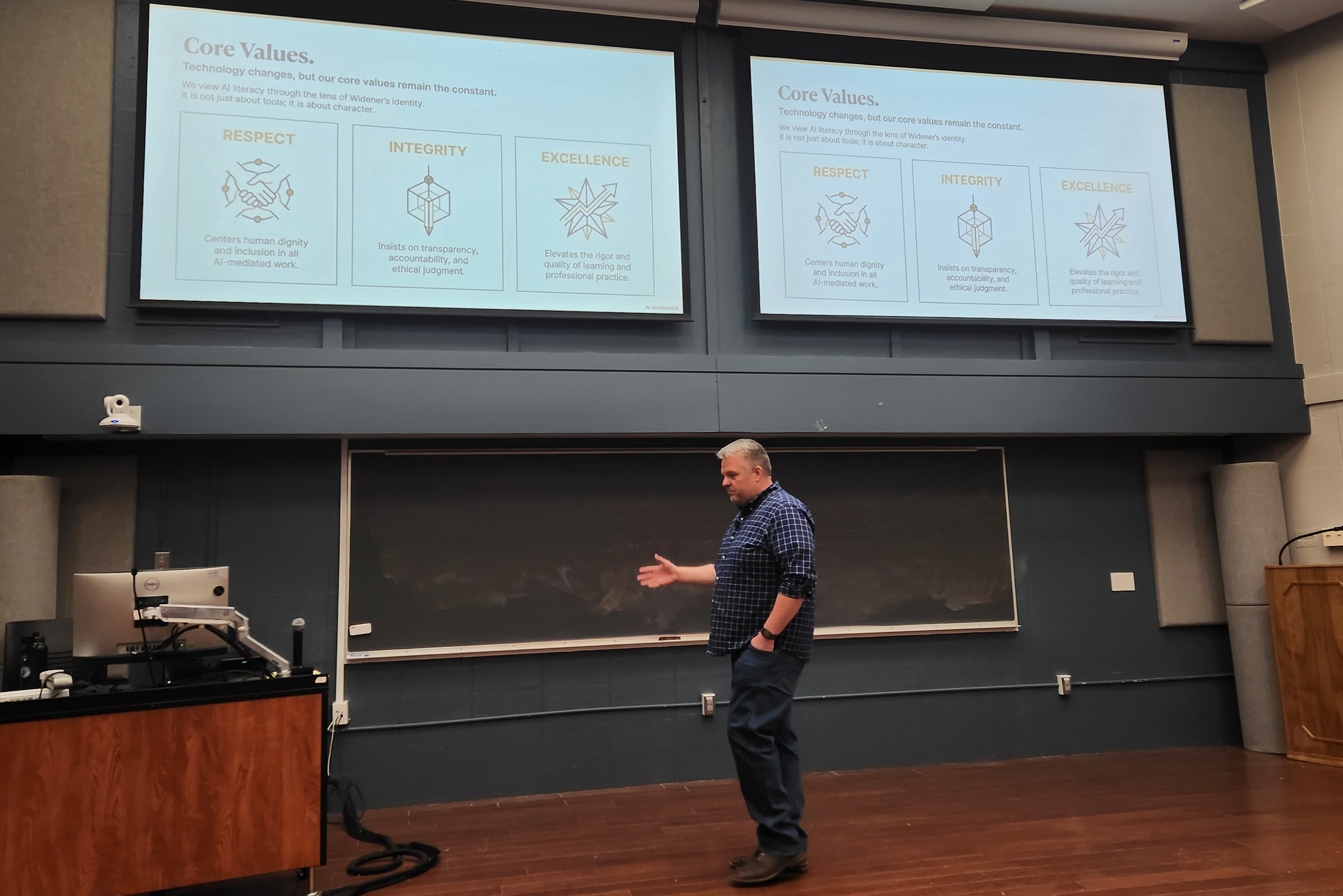
The AI Week Kickoff opened the week with a structured campus dialogue on Widener's proposed Critical AI Literacy Framework. Hosted by the LEAD-AI Council in Kapelski Learning Center Room 1, the session brought together faculty, staff, and students in a hybrid conversation designed to generate dialogue: to surface shared priorities, stress-test a working definition, and identify concrete next steps for embedding AI literacy across disciplines.

Facilitated by Tom Wilk, Chair of the LEAD-AI Council, the session used structured dialogue prompts to move quickly from framing to candid community conversation. Coffee, tea, and hot pretzels were provided; the session ran the full hour.

Event Details

  • Date: Monday, March 2, 2026
  • Time: 12:00–1:00 PM
  • Location: Kapelski Learning Center, Room 1 (Hybrid)
  • Format: Facilitated campus dialogue with structured prompts
  • Facilitator: Tom Wilk, Chair, LEAD-AI Council
  • Attendance: 31, including faculty, staff, and students
Framework

The Critical AI Literacy Framework

Widener's proposed framework articulates five core competencies expected of AI-literate graduates.

1
Understand
Know how AI systems work at a conceptual level—their capabilities, limitations, training processes, and inherent biases—without requiring deep technical expertise.
2
Apply Without Outsourcing
Use AI tools purposefully and critically—to enhance, not replace, original thought, professional judgment, and authentic learning.
3
Act Ethically
Consider the ethical implications of AI use—integrity, equity, privacy, attribution, and accountability—across academic, professional, and civic contexts.
4
Reflect on Broader Impacts
Examine AI's wider social, environmental, and political consequences—from labor displacement and environmental cost to misinformation and algorithmic bias.
5
Adapt Continuously
Develop the habits of mind to navigate an evolving AI landscape—staying curious, critical, and committed to responsible, informed practice over time.
View the Full Framework (PDF)
Key Takeaways

What We Heard

  • AI literacy is foundational, not elective. Participants consistently described it as a fundamental skill—something that must be woven across the curriculum, not confined to a single course.
  • Shared responsibility across roles. Faculty, staff, and students each have a stake in building a campus culture of responsible AI use. These groups are navigating real uncertainty together.
  • Critical thinking as the cornerstone. Critical AI literacy is not about learning which tools to use, but about developing the judgment to evaluate them and to know when and when not to use them.
  • Scaffolding is essential. Multiple voices called for AI literacy to be scaffolded systematically throughout students' academic careers, building from foundational concepts to discipline-specific application.
Attendee Feedback

Voices from the Room

"AI literacy isn't some niche skill anymore… Students graduating today are expected to understand and work alongside AI the same way they're expected to communicate clearly."
Faculty attendee
"We need to work together to ensure that this is scaffolded throughout the curriculum in all units to better prepare our students."
Faculty attendee
"It was helpful to understand Widener's vision for AI literacy. Learning about AI at all levels—students, faculty, staff, and administration—is very important."
Staff/Administrator attendee

Satisfaction Ratings

The majority of respondents rated the event 4–5 out of 5, with Strongly Agree on both perceived value and relevance to role.