Student Forum
Tuesday, March 3, 2026 4:00–6:00 PM Webb Room, University Center Student-led

"What I Wish My Profs
Really Knew About AI"

~75 students, faculty, staff, and administrators
across five discussion rooms
← Back to overview
About This Event

A Student-Led Conversation

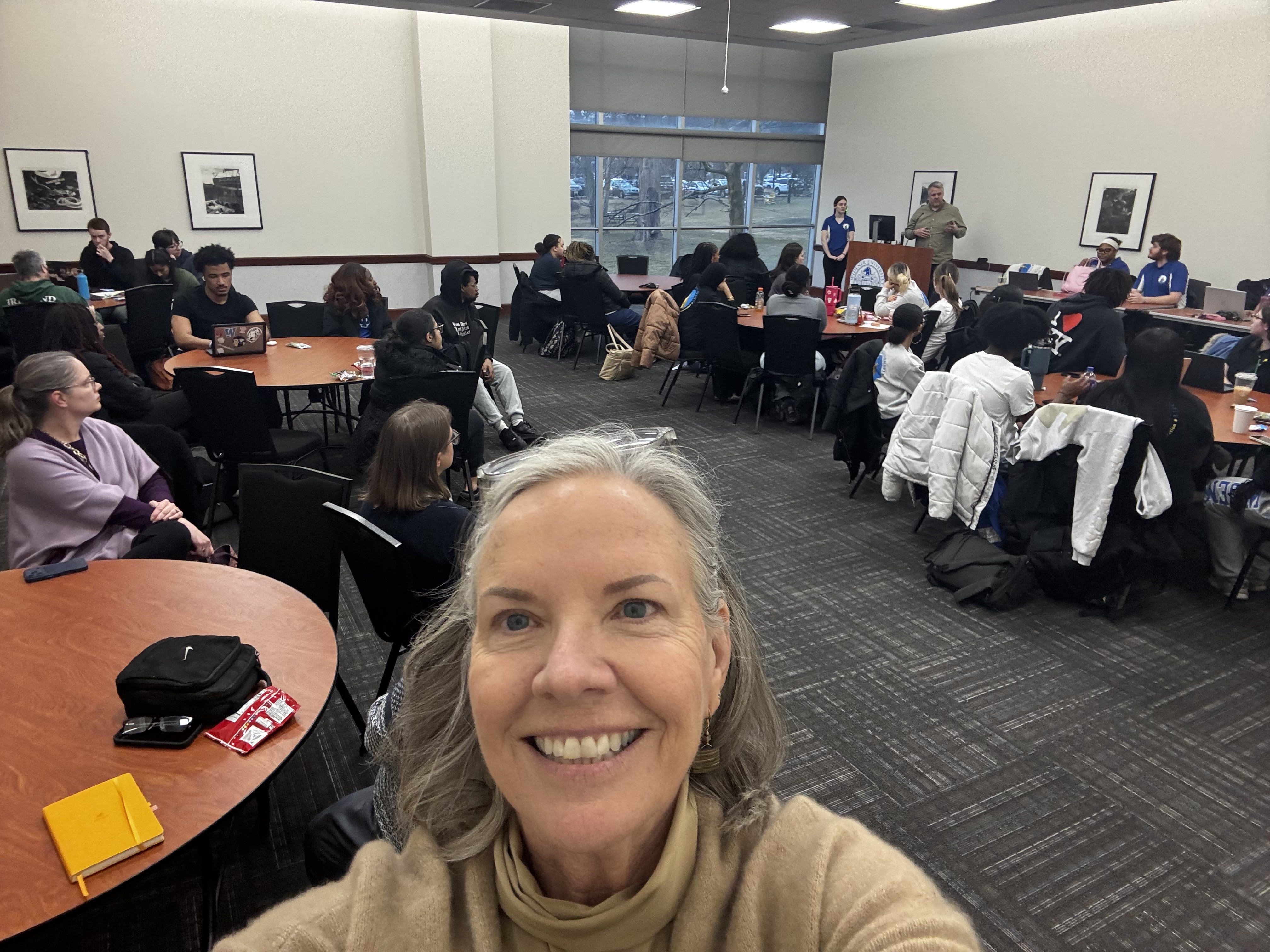
Organized by the Student Government Association and facilitated by SGA Vice President Melanie Spielberger, the Student Forum brought together approximately 75 students and a dozen faculty and staff in five simultaneous small-group discussions in the Webb Room of the University Center. Participants spent 90 minutes in student-led conversations guided by prepared questions.

The conversations were candid and wide-ranging—students and faculty wrestling together with real tensions around learning, integrity, and what AI means for their respective roles. Senior university leadership participated as room members and listeners. Rather than a confrontation between skeptics and enthusiasts, the forum surfaced something more interesting: a campus community genuinely thinking through hard questions together.

Thematic Analysis

Key Themes

Themes are ordered by breadth—how many of the five discussion rooms independently raised each topic.

1
AI as Tool vs. Crutch — The Central Tension
Raised in all 5 rooms
Every room acknowledged AI's legitimate benefits—speed, grammar support, brainstorming—while naming over-reliance as the core danger. Students articulated a key paradox: AI is most risky precisely when learners need it most, because they lack the foundational knowledge to evaluate what AI produces. Multiple rooms also noted a subtler loss—the pride and satisfaction of work diminished when AI is involved.
2
Faculty AI Use — Transparency & the Double Standard
Raised in all 5 rooms
Students across all rooms described professors who forbid AI use while simultaneously using it to generate slides, lesson plans, and grade assignments. Students did not oppose faculty AI use categorically—but demanded transparency, disclosure, and consistency. Room F made the logic explicit: if faculty use AI for lesson plans without disclosing it, it signals to students that effort no longer matters.
3
Academic Integrity & False AI Detection Accusations
Raised in 4 of 5 rooms
Four rooms surfaced the emotionally charged experience of students being falsely accused of using AI. Room C provided the most detailed accounts: one student spent two to three hours documenting that their own work was their own; another, who writes at an advanced level, is routinely flagged. Students' recommendation: build relationships, know student writing, and talk to students directly rather than relying solely on detection software.
4
Environmental & Social Justice Costs
Raised in 4 of 5 rooms
Students named—unprompted—water consumption, disproportionate environmental burdens on communities of color near data centers, digital racism in AI-generated imagery, and corporate power concentration. The framing was systemic and self-aware: "It starts with us."
5
Human Creativity, Authenticity, and the "Soul" of Learning
Raised in 4 of 5 rooms
Students consistently articulated that AI produces content but not meaning. The struggle inherent in real learning was named as having intrinsic value—"the beauty of the struggle." Discussion-based classes, oral exams, and in-person writing were proposed not just as AI-evasion tactics, but as pedagogical goods in their own right.
6
Media Literacy, Misinformation, & Epistemic Risk
Raised in 4 of 5 rooms
Students raised concerns about confirmation bias baked into AI systems, AI-generated content distorting historical narratives, and the risk of what one student called "Dark Forest Theory"—a proliferating AI-generated internet in which genuine human signal becomes increasingly difficult to find.
7
Workforce Futures — Realistic, Skeptical, and Divided
Raised in 4 of 5 rooms
Students acknowledged they will need AI proficiency but drew firm lines in high-stakes professions—nursing, law, social work—where AI cannot replace human judgment. Crucially, students reported they are already making academic and career decisions based on AI's anticipated disruption of their chosen fields.
8
University-Wide AI Access — A Concrete Recommendation
Raised by student participants in one room
Students in one leadership-attended room actively supported Widener purchasing an AI suite and making it accessible to the entire campus community. This came from the same students expressing deep concern about overuse—reflecting a nuanced position: AI is here to stay, unequal access disadvantages students who can't afford premium tools, and the university has a responsibility to level the playing field.
Recommendations

What Students Asked of Faculty

  1. Be transparent about your own AI use — disclose it, cite it, and apply the same standards to yourself that you apply to students.
  2. Don't rely solely on AI detection tools — talk to students; know their writing; build relationships that make integrity assessment possible through dialogue.
  3. Redesign assignments with learning as the point — discussion-based classes, oral exams, and in-class writing were named repeatedly as preferred alternatives to take-home formats that invite AI substitution.
  4. Teach AI ethics, not just AI use — students specifically requested courses focused on ethical AI literacy, civic implications, and real-world consequences.
  5. Require foundational knowledge before AI use — students must understand material first, or they cannot evaluate what AI produces.
  6. Acknowledge your own learning curve — students are not asking faculty to be AI experts; they ask for honesty about shared uncertainty.
Student Voices

Direct Quotes

"You don't expect me to use AI; I should expect the same of you."
Room C participant, on faculty AI use
"Just talk to students."
Room C participant, on AI detection tools
"AI cannot replace human empathy, creativity, imagination, care."
Student participant
"It gets rid of the point of spending money for college if professors are not genuinely caring about the students."
Room F participant, on faculty AI use for lesson plans

A Shared Finding

University leadership who participated noted being struck by two things: first, that students were more analytically sophisticated than expected; and second, that faculty and students shared remarkably similar fears about AI. That convergence is itself significant—this is not a faculty-versus-students problem. It is a shared institutional challenge that both groups are navigating with incomplete information, under real pressure, and with genuine stakes. A campus conversation that brings both groups into the same room is exactly the right starting point.